Monday, August 17, 2020

An Epic Fight For the Metaverse

 You might have missed it amongst all the headlines about the U.S.P.S., the 2020 elections, and, of course, that little thing we call the pandemic, but Fortnite got kicked off Apple's App Store (and subsequently Google Play).   

I'm not a gamer, but I am fascinated by gaming, because, as Steven Johnson put it, "The Future is where people are having the most fun."  Tim Sweeney, the founder and CEO of Epic Games, Inc., which makes Fortnite, seems to be having a lot of fun.  And he thinks the future is the Metaverse.  

Credit: Epic Games
Healthcare, take note.

The tech giants were reacting to Epic allowing "permanent discounts" on developer fees for in-game purchases made directly, rather than going through Apple or Google.  Developers thus avoid the 30% commission charged in those Stores.  Mr. Sweeney has been railing about the commission level for some time, leading to the recent decision.

Apple tried to justify its action:

Today, Epic Games took the unfortunate step of violating the App Store guidelines that are applied equally to every developer and designed to keep the store safe for our users. As a result their Fortnite app has been removed from the store. Epic enabled a feature in its app which was not reviewed or approved by Apple, and they did so with the express intent of violating the App Store guidelines regarding in-app payments that apply to every developer who sells digital goods or services.

Epic had, not surprisingly, already gamed this out: it immediately sued both Apple and Google in federal court, charging:

Apple’s removal of Fortnite is yet another example of Apple flexing its enormous power in order to impose unreasonable restraints and unlawfully maintain its 100% monopoly over the” market for in-app payments on iPhones.

Even better, they rolled out a slick ad, its own version of Apple's iconic 1984 ad attacking IBM:

Mr. Sweeney charged: "We must all choose to fight a painful battle now, or accept an all-powerful middleman with unbounded ambition to extract tribute and limit innovation in the decades to come."  

All this is happening, of course, when regulators in both the U.S. and Europe are eying tech giants warily for monopolistic actions, so kicking off a major app because it wouldn't say a tribute -- umm, "commission" -- means they feel there is a lot at risk here.  In just three years, Fortnite has accumulated some 350 million users worldwide.  

Some view this as just about money, a tech giant battling two bigger giants for more favorite deals.  Mr. Sweeney see it as a fight about platforms and exactly what a platform can dictate to its users.  He tweeted: "We're fighting for open platforms and policy changes equally benefiting all developers. And it'll be a hell of a fight!"   

In an interview with Joseph Kim, Mr. Sweeney said:

...they say something is only a platform when the majority of the profit is made by creators rather than the company that built the thing right? Windows is a platform. Gee, is iOS a platform? Not sure.

It should be noted that Epic offers its own platform, Epic Games Store.  More importantly, Epic is more than Fortnite; in addition to its Store, it has a game development software (Unreal Engine), the game/social network Houseparty, and this spring hosted a virtual concert watched by more than 12 million people.  Mr. Sweeney has made it clear: Epic is gearing up for the Metaverse, which some believe will be "the next version of the Internet."  

The concept of the Metaverse has been around for years -- science fiction writer Neil Stephenson is believed to have first introduced it in his 1992 novel Snow Crash -- but Mr. Sweeney elaborated on it in his interview with Mr. Kim:

Apple, he charges, "has outlawed the Metaverse," since it does not permit "cross-platform ecosystems and games," something he has pushed for years.   The Metaverse, he believes, "It’s going to be from more and more companies and brands connecting their products and services until you have a much, much more open thing that everybody participates in...And so it’s in everybody’s interest to really interconnect and standardize over time."  

Mr. Kim put it to him directly:

I think of all this in contrast to healthcare.  Oh, sure, healthcare has plenty of middlemen, each collecting its "tribute" and too many of them limiting innovation.  But while Mr. Sweeney and others are looking for the next version of the Internet, healthcare hasn't even gotten to the platform stage, much less platforms with open standards, interoperability, "healthy competition at every point," and real time collaboration, eventually in 3D space.  

Healthcare still works in your grandfather's economy and uses your parents' Internet.  

Look, I don't really care if I can't download Fortnite from either App Store.  I don't have strong feelings about whether 30% is a "fair" commission for Apple and Google.  I do wonder what healthcare's first real platform will be, and worry that, once it comes, it will stifle competition and innovation rather than spur it.  I'm all in on cross-platform products and services, with open standards and interoperability, especially for healthcare.

Most of all, I wonder who healthcare's Tim Sweeney is -- fighting to open up today's "system" and thinking hard about what comes next, whether that be the Metaverse or something else we haven't imagined yet.  

As Mr. Sweeney said: 

I think we should all be advocates for the world that we want. If we aren’t forceful and fighting for the world that we want...then we’re going to get a very different world. And by the time it’s set in stone, it’s going to be too late to change it.


Monday, August 10, 2020

Take Your Mom To Work

If you are a working mom, or married to one, or simply know one, you know that it is tough to balance a job and raising a child even under ideal circumstances.  Even if she has a supportive spouse, chances are that it is the mom who ends up providing the most child care, and whose career it impacts the most.

Credit: iStock
But, of course, these are not ideal circumstances.  Prior to the pandemic, women had made great strides in the workforce; more women had payroll jobs than men, for example (although they continued to be paid less for them).  Those gains quickly came crashing down once the pandemic hit.  It is believed to be the first time that job and incomes losses have hit women harder than men.  Some are calling our pandemic-driven economic downturn a "shecession" as a result.   

That's bad enough, but the even bigger danger is that the pandemic could set back women's careers for a generation. 

A recent study by Collins, et. alia confirmed what most might have guessed: in the wake of the pandemic, women are more likely than men to have reduced their work hours to take on additional child care responsibilities due to school/daycare closing -- four or five times as much.  

The study found that:

Scaling back work is part of a downward spiral that often leads to labor force exits—especially in cases where employers are inflexible with schedules or penalize employees unable to meet work expectations in the face of growing care demands.  

We are also concerned that many employers will be looking for ways to save money and it may be at the expense of mothers who have already weakened their labor market attachment.

Even more worrying, lead author Caitlyn Collins, a professor at Washington University, says: "Our findings indicate mothers are bearing the brunt of the pandemic and may face long-term employment penalties as a consequence."  

Five-Thirty-Eight's Neil Paine and Amelia Thomson-DeVeaux analyzed how the pandemic could "force an entire generation out of the workforce."  It starts with availability of child care, as shown in this chart:

Combine that with uncertainty about schools reopening and it makes child care decisions extremely tough.  Women with young children were already less likely to be in the workforce than other women, they point out, with caregiving cited as a major reason, and the pandemic is exacerbating the effect.  "Leaving the workforce," they note, "even if it’s just for a year or two, has ripple effects that can follow a woman for the rest of her life, even depressing her earnings in retirement."  

"We’re in danger of erasing the limited gains we’ve made for women over the past few decades, and especially women of color,” Melissa Boteach of the National Women's Law Center told them.  

Trying to get the economy open again without figuring out how we're going to support working moms is a "recipe for a generational wipeout of mothers’ careers," Joan Williams, University of California Hastings College of Law and founder of the Center for WorkLife Law, told The Wall Street Journal.  

The WSJ article cites a Boston Consulting Group survey from this spring that found that both men and women were spending more time on domestic chores than pre-pandemic, but that the gap between women and men had increased from 10 hours per week to 15 hours.  "That’s almost two days more of a secondary job,” Matt Krentz, a managing director at BCG told WSJ. “When the trade off comes and it’s not sustainable, the solution often falls to the woman taking the step back.”

The article notes: "People who drop out of the labor force for an extended period not only miss out on pay, they also often fall behind on raises that come from longer tenure and employer contributions to retirement accounts."  When you see "people," read "women."

Betsy Stevenson, a University of Michigan professor of economics and public policy, told The New York Times, "We could have an entire generation of women who are hurt.  They may spend a significant amount of time out of the work force, or their careers could just peter out in terms of promotions."  

Professor Stevenson summed up what may be the core issue: "This pandemic has exposed some weaknesses in American society that were always there, and one of them is the incomplete transition of women into truly equal roles in the labor market.”

Deb Perelman, writing in The New York Times, puts the dilemma succinctly:  "In the Covid-19 economy, you’re allowed only a kid or a job."  She goes on to add:

The long-term losses for professional adults will be incalculable, too, and will disproportionately affect mothers. Working mothers all over the country feel that they’re being pushed out of the labor force or into part-time jobs as their responsibilities at home have increased tenfold.

It's outrageous, Ms. Perelman believes, and she wonders: 

"Why isn’t anyone talking about this? Why are we not hearing a primal scream so deafening that no plodding policy can be implemented without addressing the people buried by it?"

Why, indeed.  

In an op-ed in The New York Times, Professor Williams asserted: 

We’re in this mess because, even before coronavirus, the legal protections for working mothers consisted of a convoluted matrix of federal, state and local laws...The lack of straightforward legal protections is just one of many ways that public policy fails mothers; the haphazard nature of Families First is merely one symptom of a broader problem.

As The New York Times noted: "In countries that offer more comprehensive support for families — like Germany, France, Canada and Sweden — a significantly larger proportion of women are in the labor force."   

This is, of course, an issue of particular importance to healthcare. According to the Census Bureau, women make up 76% of the healthcare labor force. Child care considerations may drive much of the gender imbalances by specialty for women physicians and other healthcare workers. When COVID-19 hit, essential healthcare workers struggled to find child care that allowed them to keep working. These factors shape our healthcare workforce and our healthcare system.

It's hard to picture now, but the pandemic will eventually pass.  Perhaps we'll get a vaccine, perhaps it will have to run its course through the population.  Most, but not all, jobs will come back; the economy will improve.  We'll settle into a new normal.  All that will cost trillions of dollars, hardships for millions, and way, way too many lives.  

Most of the damage, though, will be measured in months or years -- not generations.  Unless we proactively take action, though, these impacts on women's careers can be generational.  The pandemic may galvanize action on, for example, unemployment programs/systems and our healthcare system.  We need that same will to action on supporting working moms, such as through better family leave and child care policies.

Do it for your mom. 


Wednesday, August 5, 2020

The Not-So-Odd Couple: Microsoft Pursues TikTok

TikTok keeps generating interesting news.  In the past week, it is about Microsoft's pursuit of it -- fueled by the U.S. government's not-too-subtle nudging.  Each time I write about TikTok I thought it'd be the last, but how could I resist that?

I first wrote about the potential implications of it being China's first AI-based Internet success outside of China.  My second piece discussed the security concerns that raised with many observers.  My latest article discussed how TikTok users were using it to power social protest.

Those security concerns never went away, and they (or perhaps anger at TikTok possibly helping undercut President Trump's Tulsa rally) spurred the President to threaten a ban (as India had just done).  It is not at all clear that the U.S. could actually implement such a ban, but users went nuts anyway.  "Everyone is running around like a chicken with their head cut off," one user told The Wall Street Journal.  

Then things got really interesting.  ByteDance, TikTok's owner, said it would consider selling TikTok's U.S. operations.  Fox News, which first reported the talks a month ago, when President Trump had first brought up the potential ban.  Numerous outlets confirmed late last week that talks were now at an "advanced stage."  The deal is expected to also include Australia, Canada, and New Zealand.

Credit: GeekWire
The President almost scuttled the deal before it got any further, but relented after a weekend call from Microsoft CEO Satya Nadella.   Microsoft has committed that it would bring TikTok's code to the U.S. -- believed to be some 15 million lines of A.I. code -- within a year, and protect the consumer data.  It set September 15 as the deadline for a deal.  

Experts suggest the deal could be for as much as $30b.

Many wondered at Microsoft being the lead suitor.  Mr. Nadella is doing his best to change Microsoft's sometimes stodgy image, but it still has been viewed as more corporate-oriented.  Former Microsoft executive S. Somasegar told The Wall Street Journal: "If you look at the major acquisitions over the last five years or so, the common theme is to acquire a vibrant community of customers that is both critical and net new add to the Microsoft community."  TikTok users certainly count as "vibrant."

Microsoft is already extremely strong in both cloud computing and artificial intelligence, both of are key to the deal.  Oren Etzioni, chief executive of the Allen Institute for Artificial Intelligence, told The Washington Post: "If AI is the new electricity, the fuel that powers these plants is data."   All that content are data.

Keep in mind that content going viral on TikTok isn't a function of who you know or how many followers you have, but if/how TikTok's A.I. promotes it.  ByteDance is an A.I. company and that drives TikTok's success.  For anyone interested in A.I. -- and what tech company isn't? -- that makes TikTok extremely attractive, not to mention for its legions of rabid users.

Microsoft has had success among younger people with its Xbox platform, and hopes for more from its Minecraft acquisition and Hololens platform, but TikTok could be a breakthrough.  As one user explained to The Washington Post: "People might think it’s just an app where people do 15-second dances, but it’s so much more.  The app speaks to my generation — yes, we share music and dances, but we also share ideas and views on the world."  

Dan Ives, an analyst at Wedbush Securities, told The New York Times: "Microsoft is viewed as your grandpa’s company, and it is trying to change that.  Microsoft goes from an uncool company to many under 25 to potentially as hip as TikTok if they get this done."

Take that, Factbook.  

Instagram Reels
Facebook, of course, is not sitting idly.  Today it launched Instagram Reels, "a new way to create and discover short, entertaining videos on Instagram."  It is now available in 50 countries, including the U.S., and obviously has been under development for some time.  TechCrunch's analysis is that "Instagram’s goal is not just to capture the now potentially up-for-grabs TikTok audience in the U.S. — it’s to steal them away even if TikTok remains."  

Although Instagram may be TikTok's most formidable competition, others are also trying to take advantage of the current uncertainty to steal some of its audience, such as byte, Clash, or Triller.  

There are many potential bumps in the road.  For example, what does it even mean to split the four impacted countries apart from the rest of the world?  As The Verge commented:
No one has ever acquired a regional section of a social network before, and peeling away the Microsoft-owned portion of TikTok will be harder than it looks. As TikTok officials keep reminding us, the app is based in California, but the majority of its users are still in Asia or Europe.  
Negotiating the code and the content in such a split scenario complicates things greatly.  Systems engineer Karl Higby told The New York Times: "In order to personalize the app for existing users, they’re going to need historical data for U.S. folks unless they want to wipe the slate clean, which would be a terrible user experience."  Historical data from non-U.S.users helps drive current algorithms, so the user experience may be altered in any event.
 
Plus, of course, the regulatory scrutiny will continue, and Microsoft would face the same kinds of concern over its content and privacy practices that Facebook and other social media platforms have.   Gigi Sohn, Georgetown Law Institute fellow and former FCC advisor, warned in The New York Times: "
Microsoft is buying itself real aggravation."  

Still, though, the opportunity to obtain an asset like TikTok may be a once-in-a-generation opportunity for Microsoft.  Mr. Ives thinks the deal could add $200b to Microsoft's market cap within three years, adding:  
An aggressive acquisition (or strategic investment) of TikTok would be Microsoft throwing its hat in the ring and trying to compete with other tech giants such as Facebook in a new avenue of growth for the next decade for its consumer business.
Or, as Hank Green, CEO of Complexly, told The New York Times, "If I had the opportunity to buy TikTok, I’d buy TikTok.  There’s so much value on that platform right now that is completely untapped.”

Frankly, I don't know if the deal will happen or what TikTok might end up being worth to Microsoft, but I sure am interested to see what happens next.  

Saturday, August 1, 2020

Health Insurance Needs to Grow Up

I've been covered by private insurance my entire life.  Even more telling, I worked in the health insurance industry for -- gasp! -- some thirty years.  It's not just paid for my healthcare, it's financed my life.

Today, though, for the first time in my life, I'm covered by public insurance -- and I couldn't be more relieved.
Credit: WorkLife Partnership
Now, I'm not going to go all Wendell Potter.  I know many people have their health insurance horror stories, but, sadly, people have them about pretty much every part of the healthcare industry.  I believe most people working in health insurance, like most people working in healthcare generally,  sympathize with the people they serve and are just trying to do a good job.

The problem is that the health insurance model has outgrown the times.  I'll try to explain some ways how.

Premiums
Once upon a time, most people had employer coverage, and those employers paid all or most of its cost.  Those days are gone.  Employer coverage is still the predominant form of private health insurance, and employers still pay the majority of its cost, but percentage of people with employer coverage continues to drop and the amount they pay for it continues to increase.

Kaiser Family Health's 2019 Employer Health Benefits survey found that annual premiums for family coverage topped $20,000, with employees paying $6,000.  The average income for workers is $48,000.  Those premiums are awfully daunting -- yet people in the individual market would long for those numbers.

The fact is, premiums have become unaffordable for most Americans.  If you have a marketplace plan you might quality for a premium subsidy, and if you have employer coverage your employer might vary contributions by salary, but there's few of us who don't take a gulp at every premium payment, especially given the prospect that they're only going to keep going up.

Our scattershot, segmented, and inequitable mechanism for financing health insurance is no longer sustainable.  We need a more universal financing mechanism -- such as taxes -- that is based on wealth/income/ability to pay.  

Cost-Sharing
Once upon a time, point-of-care cost-sharing was minimal.  Those days are also gone.   Deductibles, copayments, and coinsurance have soared, even though ACA sought to at least place limits on the resulting out-of-pocket expenses.  Cost-sharing was originally intended to help deter unnecessary care, but have become more of a way to shift costs to consumers.

Credit: eHealth
As a result, nearly one-in-four report skipping medical care due to cost, with some estimates even higher (Gallop, 33%; HealthPocket 51%).  Again, ACA tried to mitigate this by mandating no cost-sharing for preventive care, but when, for example, 25% of diabetes can't afford their insulin, it's evident that cost-sharing has become punitive.

Some types and levels of cost-sharing may be appropriate, but it needs to be highly targeted and affordable.  Our current shotgun approach to it is harming more than it helps.  

Networks
There are too many stories of people getting astronomical out-of-network bills, often for healthcare professionals they didn't choose and may not have even known about.  Plus, your favorite in-network doctor or hospital may suddenly drop out -- or be dropped.  The same can happen with your prescription drugs.

It is true that networks do offer substantial "savings" from non-discounted charges, but that reflects more how outlandish the latter usually are.  Networks purport to be chosen at least in part on "quality," but measurement and demonstration of that remains elusive.  They represent a failure of the market, not a sign of its value.

We should all want patients to use the best possible healthcare professionals for their needs.  We should expect that the cost of those professionals should be directly related to the outcomes they deliver to their patients, and known in advance.  But, instead, we have networks that drive volume to those professionals and organizations who happen to contracted with our health insurer.  That's not a recipe for our best health.

Can we focus on getting patients to the right professional at the right time and place, for the right price?

Scope of services
When I said I now had public insurance, I overstated the case.  I have Medicare Parts A and B, but my Part D coverage is delivered by a private insurer, although largely funded by public dollars.  Like most on Medicare, I also have a Medicare Supplement, delivered by a private insurer.  And I still have private dental and vision insurance, not to mention auto, homeowners, and long-term care insurances that each also cover some health expenses.

Thought experiment: you're driving while talking to your boss on the phone, get distracted and smash into a tree on someone's lot.  Fortunately, your most serious injury are a broken jaw and some broken teeth.  The question is: who pays?  Your health insurance?  Your dental insurance?  Workers compensation?  Your auto policy?  The homeowners policy?  Why is my mouth -- and, for that matter, my eyes and eyes -- almost always treated differently when it comes to insurance?

The answer to the thought experiment -- and I honestly do not know what it is -- will dictate which healthcare professional you see, how much they can charge you, and how much of that you have to pay.  That is, in a word, crazy.

And it is not just insurance, it also goes to how we educate and license healthcare professionals.  It's what I called the Animal Farm of healthcare: all services are equal, but some are more equal than others.

We need to step back and develop a comprehensive view of what is necessary for our health, how we assure we get it, and how we finance it.  
--------------

I'm glad I no longer have employer coverage, where the employer chooses my network, level of care, cost, and even covered services -- and which I lose if I lose or change my job.  I'm glad I no longer have marketplace coverage, where the insurer can just drop out of the market.  Still, though, I regard Medicare as pretty clunky -- a 1960's (BCBS) design spiffed up with more modern touches like prescription drugs and preventive care, financed and delivered in a variety of ways.  It is not what one would design if starting from scratch.

So let's do that: for private insurance and for public insurance: let's rethink from basic principles and agreed-upon goals.  Let's design a health financing and delivery system for the 21st century.

We can certainly do better, if only because we could hardly do worse.

Monday, July 27, 2020

Too Many Small Steps, Not Enough Leaps

I was driving home the other day, noticed all the above-ground telephone/power lines, and thought to myself: this is not the 21st century I thought I'd be living in. 

When I was growing up, the 21st century was the distant future, the stuff of science fiction.  We'd have flying cars, personal robots, interstellar travel, artificial food, and, of course, tricorders.  There'd be computers, although not PCs.  Still, we'd have been baffled by smartphones, GPS, or the Internet.  We'd have been even more flummoxed by women in the workforce or #BlackLivesMatter. 

We're living in the future, but we're also hanging on to the past, and that applies especially to healthcare.  We all poke fun at the persistence of the fax, but I'd also point out that currently our best advice for dealing with the COVID-19 pandemic is pretty much what it was for the 1918 Spanish Flu pandemic: masks and distancing (and we're facing similar resistance).  One would have hoped the 21st century would have found us better equipped.

So I was heartened to read an op-ed in The Washington Post by Regina Dugan, PhD.  Dr. Dugan calls for a "Health Age," akin to how Sputnik set off the Space Age.  The pandemic, she says, "is the kind of event that alters the course of history so much that we measure time by it: before the pandemic — and after."  

In a Health Age, she predicts:
We could choose to build a future where no one must wait on an organ donor list. Where the mechanistic underpinnings of mental health are understood and treatable. Where clinical trials happen in months, not years. Where our health span coincides with our life span and we are healthy to our last breath.
Dr. Dugan has no doubt we can build a Health Age; "The question, instead, is whether we will."

Dr. Dugan head up Wellcome Leap, a non-profit spin-off from Wellcome, a UK-based Trust that spends billions of dollars to help people "explore great ideas," particularly related to health.  Wellcome Leap was originally funded in 2018, but only this past May installed Dr. Dugan as CEO, with the charge to "undertake bold, unconventional programmes and fund them at scale."  Dr. Dugan is a former Director of Darpa, so she knows something about funding unconventional ideas.

Leap Board Chair Jay Flatley promised: "Leap will pursue the most challenging projects that would not otherwise be attempted or funded. The unique operating model provides the potential to make impactful, rapid advances on the future of health."  

Now, when I said earlier that our current approach to the pandemic is scarily similar to the response to the 1918 pandemic, that wasn't being quite fair.  We have better testing (although not nearly good enough), more therapeutic options (although none with great results yet), all kinds of personal protective equipment (although still in short supply), and better data (although shamefully inconsistent and delayed).  We're developing vaccines at a record pace, using truly 21st century approaches like mRNA or bioprinting.  

The problem is, we knew a pandemic could come, we knew the things that would need to be done to deal with it, and yet we -- and the "we" applies globally -- fumbled the actions at every step.  

We imposed lockdowns, but usually too late, and then reopened them too soon.  Our healthcare organizations keep getting overwhelmed with COVID-19 cases, yet, cut off from their non-pandemic revenue sources, are drowning in losses.  Due to layoffs, millions have lost their health insurance.  People are avoiding care, even for essential needs like heart attacks or premature births.  

Our power lines are showing.  The the hurricane that is the pandemic is knocking them down at will.  We might have some Health Age technologies available but not a Health Age mentality about how, when, and where to use them. 

Dr. Dugan thinks she knows what we should be doing:
To build a Health Age, however, we will need to do more. We will need an international coalition of like-minded leaders to shape a unified global effort; we will need to invest at Space Age levels, publicly and privately, to fund research and development. And critically, we’ll need to supplement those approaches with bold, risk-tolerant efforts — something akin to a DARPA, but for global health.
Unfortunately, none of that sounds like anything our current environment supports.  The U.S. is vowing to leave the World Health Organization and is buying up the worlds's supply of Remdesivir, one of the few even moderately effective treatment options.  An "international coalition of like-minded leaders" seems hard to come by.  Plus, only half of Americans say they'd take a vaccine even when it is here.

If COVID-19 is our Sputnik moment, we're reacting to it as we did Sputnik, setting off insular Space Races that competed rather than cooperated, focused narrowly on "winning" instead of discovering.  We will, indeed, spend trillions on our pandemic responses, but most will be short-term, short-sighted programs that apply band-aids instead of establishing sustainable platforms and approaches.  We're reacting to the present, not reimagining the future.

Credit: Darpa
Darpa's mission is "to make pivotal investments in breakthrough technologies for national security," and it "explicitly reaches for transformational change instead of incremental advances."  Her background at Darpa make Dr. Dugan uniquely qualified to bring this attitude to Leap, and to apply it to healthcare.  

The hard part is remembering that it is not about winning the current war, or even the next one, but about preparing for the wars we're not even thinking about yet.  

Most of our population are children of the 20th century.  Our healthcare system in 2020 may have some snazzier tools, techniques, and technologies than it did in the 20th century, but it is mostly still pretty familiar to us from then.  If we truly want a Health Age, we should aspire to develop things that would look familiar to someone from the 22nd century, not the 20th.

Every time I read about the latest finding about our microbiome I think about how little we still know about what drives our health, just as our growing attention to social determinants of health reminds me how we need to drastically rethink what the focus of our "healthcare system" should be. 

Not more effective vaccines but the things that make vaccines obsolete.  Not better surgical techniques but the things that make surgery unnecessary.  Not just better health care but better health that requires less health care.  If we're going to dream, let's dream big. 

That's the kind of Leap we need. 

Monday, July 20, 2020

Healthcare Needs Some #GoodTrouble

As hopefully most of you know, Rep. John Lewis, civil right icon and longtime member of Congress, died this past Friday.  Rep. Lewis was often described the "conscience of Congress"  - perhaps a low bar in today's Congress but important nonetheless -- for his unwavering commitment to social justice.  I have always been struck in particular by one of his quotes:
Rep. Lewis must have been heartened by the fact that, in 2020, plenty of people are, indeed, making noise and getting into good trouble, necessary trouble over issues that he cared deeply about, like Black Lives Matter and voting rights.  There are others who are better able to write about those people and that trouble.  So I'd like to talk about his call to action with respect to healthcare.

If you are working today in healthcare -- especially in the United States -- or, for that matter, someone getting healthcare or having a loved one get it, then you should be making some noise and getting into good trouble, because our healthcare system most definitely makes it necessary.

It should come as no surprise that we're not very happy with our healthcare system, rating it lower than do citizens in most other developed countries.  And for good reason: it's the world's most expensive while delivering sub-par health results and leaving tens of millions without financial protection.  Even our physicians don't like it.  Even our latest, best effort for improving the sorry state of our healthcare system -- the Affordable Care Act  - is under risk of repeal due to a lawsuit brought by 18 states and backed by the Trump Administration. 

Every day, too many of us suffer in the healthcare system, ranging from waits to indignities to critical mistakes, and some face financial ruin due to the care -- whether good or bad.  Most of us suffer in silence, or only complain to our friends and family.  We don't see a lot of mass protests about the pitiful state of our healthcare system, and I have to wonder why. 

We have to stop being so passive.

For those of you working in healthcare, here are the first two things I'd urge you to get into good trouble about:


Credit: FreePik
The first admonition comes from a movement developed by Melinda Ashton, MD at Hawaii Pacific Health.  She started asking front-line workers to identify things that were "poorly designed, unnecessary, or just plain stupid," and -- not surprisingly -- there turned out to be a lot.  Someone just needed to ask and to promise some action.

Why every healthcare system/organization does not have such a program is beyond me, because those front-line workers see those kinds of things every day.  They probably do make some noise about them, but many may not be willing to get into good trouble over them, nor are they usually supported by their leaders to do so.  

But, still, they should be trying.

The second comes from advice that Dan Gingiss gives about improving customer experience.  Our healthcare system is the world's largest Rube Goldberg machine, complicated beyond understanding and with much of that complexity not achieving intended goals.  "Complicated" isn't the same as "sophisticated," much less "better."

Yet we continue to add complexity, layering new technologies onto old, inserting new layers and new types of intermediaries, all of which adds costs.  Even things that aren't inherently stupid are usually more complicated than is absolutely essential.  

Before we make things even more complicated, we should focusing on making the simple things better.  Who is getting into good trouble about that?    

I'll give some other examples.  The Commonwealth Fund and Manett just put out a report about transforming primary care for women, and one of the recommendations was the recommendation to expand women's leadership in healthcare.  As one of the authors, Lisa Suennen, wrote in her blog:
In a field where only 4% of all healthcare company CEOs are women and only 19% of hospital CEOs are women (a subset of the other number), policy is made by men. Physician education is also designed by men, who make up 2/3 of active physicians and 84% of the deans and department chairs at the 154 member medical schools in the United States. 
It shouldn't just be about primary care, nor even just about women.  If the leadership at your healthcare organization doesn't resemble the workers in it, or, equally important, the people receiving care from it, then you should be making noise.  That's worth getting into good trouble about.  That's necessary trouble. 

Or take prices.  As expensive as our healthcare system is, we've known for a long time that our problem isn't getting too many healthcare service as it is the prices we pay for them.  If you're working in a healthcare organization that charges the people without health insurance much more, you should be making noise.  If your organization is also suing those patients to collect the resulting debts, you should be getting into good trouble to try to stop it. 

And, of course, if you are working in a healthcare organization where you see patients getting services they don't actually need, or, worse yet, delivering substandard care, then you really should be making noise and getting into good trouble.    That is definitely necessary trouble.

But it's not only those working in healthcare.  If you or your loved one is receiving care, you should be making noise when you aren't treated with respect, or when you don't get the information you need.  Standing up for your rights, especially the right to make informed decisions about your care and your health, is worth making good trouble about.  It is necessary. 

All of us should be getting into good trouble about the shameful health disparities in our nation, which reflect the equally shameful socio-economic disparities we have allowed to persist.  All of us should be getting into good trouble about the fact that a healthcare episode can wipe out a families' savings, even if they have health insurance.  All of us should be making good trouble about how much our nation spends on healthcare for such a poor health return. 

We can't be afraid to make some noise about healthcare.  We must be willing to make good trouble about the many, deep, and pervasive problems in our healthcare system.  If that isn't necessary trouble, I don't know what is. 

Monday, July 13, 2020

Virtually Better

The COVID-19 pandemic couldn't have come at a better time for virtual reality.  It has caused many workers to work remotely, introducing many workers to collaborative tools like Slack or Microsoft Teams and even more to video platforms like Zoom or Skype.  But we're just beginning to understand what collaboration could look like -- such as virtual reality (VR).

As CNBC noted: "Virtual reality is booming in the workplace amid the pandemic."  Even a pre-pandemic Perkins Coie survey, done for the XR Association, predicted an explosion of immersive technologies like VR, augmented reality (AR), and mixed reality (MR).   Elizabeth Hyman, President of XRA, said: "We are at the precipice of an integration of XR technology that will transform businesses and society for the better.”  

The report expected healthcare to be the industry most impacted by immersive technologies (outside of gaming/entertainment).
Spatial virtual meeting.  Credit: Spatial
Take VR-start-up Spatial, which thinks it has a better mousetrap.  Chief Product Officer described their solution to MIT News:
Spatial is a collaborative, holographic, augmented reality solution.  You can teleport to someone’s space, work as an avatar sharing that 3D space, and use it instead of a screen to manage a project, present an idea, and more.
Don't you love the "and more," as though the teleportation wasn't enough? 

Spatial has been around since 2016, but in the wake of the pandemic Spatial made its enterprise version of the platform free.  It works on most virtual reality headsets, although there is a web browser version that can be used without a headset.  Design and engineering companies have been the biggest users, but that is changing.  "After coronavirus, interest went up 1,000 percent," Dr. Lee said, "and a big part of that was from smaller businesses, hospitals, schools, and individuals."  

In the shared workspace, people -- or rather, their avatars -- can use whiteboards, share sticky notes, build and use 3D models, even give each other high fives.  Here's a short promotional video:
Dr. Lee points out:
There’s a lot of Zoom fatigue right now, and I think the biggest reason why is because the video format really forces you to be 200 percent focused when you’re presenting or listening, but you can’t do something together.  You can’t be in this space, looking at things together and pointing at things. This feeling that we’re in the same space can only be achieved through a 3D physical office, and that’s some of what Spatial is trying to achieve in virtual form.
Microsoft, for one, is not sitting idly.  It just introduced a "Together Mode" to its Teams platform, which "uses AI segmentation technology to digitally place participants in a shared background, making it feel like you’re sitting in the same room with everyone else in the meeting or class."  It is supposed to allow participants to pick up on faces, body language, and other non-verbal cues.

Here's Microsoft's promotional video:

Marissa Salazar, Product Marketing Manager, told TechCrunch's Frederic Lardinois: "you’ll notice the way that we’re looking at each other is obviously very different than something we’re used to, not only are we out of the grid, but we’re looking at this, ‘mirror image’ of ourselves."  Microsoft's research suggests that, based on monitoring brain activity, participants using the Together Mode exerted less mental effort than in the traditional grid mode, thus reducing meeting fatigue. 

Currently, the shared space is an auditorium, but additional views are expected to be available soon (including a coffee shop for smaller meetings).  Famed VR pioneer Jaron Lanier, who worked with Microsoft on the new tools predicts: “We’ll see people make the space their own, just like they do the workplace, for the type of social dynamics that may exist.  I think where this is headed is a lot more flexibility and customization.”

At the same time, Teams is introducing Dynamic View to "dynamically optimize shared content," allowing more control over how users see content and other participants.    

Mr. Lanier says: "In a sense, it’s just a simple design strategy.  In another sense  it’s a design strategy that benefits from many years of studying mutual perception, particularly in virtual reality."  

Take a look, for example, of what Imperial College (London) claims is the first virtual ward round for medical students, using HoloLens.  The attending physician sees the patient in person, and streams the visit to literally hundreds of medical students.  The Guardian reports: "Teachers are able to pin virtual pictures to the display, such as X-rays, drug charts or radiographs, or draw lines to highlight something they want to emphasise."  

One medical student gushed: 
Despite the ward round being virtual, it felt far from it – we were expected to ask questions and think about clinical problems in real time.  It was really helpful to be able to access investigations like X-rays and blood tests in an instant, and the way the information was projected felt natural.
Now imagine what that experience could be like using Spatial. 

Last year I suggested that EHRs needed a new metaphor; instead of just being digital versions of paper records, they should be collaborative tools like Slack or Teams.  Now I'll go further: they should be a "collaborative, holographic, augmented reality solution,"  Oh, wait, that's Dr. Lee's description of Spatial's solution. 

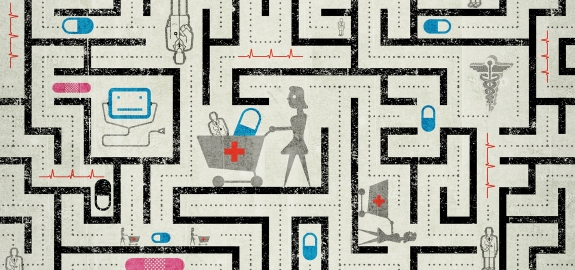
Spatial's slogan is "How Work Should Be," but it's not how healthcare is.  Healthcare is full of telephone calls, long waits, 1-on-1 meetings, incomplete or incomprehensible data, even faxes.  It is a maze we navigate anxiously, and sometimes get lost in.

For many, perhaps even most of us, our healthcare journey is a team effort, not just with our healthcare professionals but also our support system.  We need better ways to visibly present, interpret, and use our data, and to get that data to the right people at the right time. 

We need XR healthcare.

I don't want to live in the metaverse (as Neal Stephenson termed it thirty years ago) and I certainly don't want to live in our current pandemic world any longer than I need to, but the pandemic is helping us discover new ways to do things.  The shared, collaborative world that companies like Spatial or Microsoft are working towards is one that I hope we keep, especially in healthcare.