Tuesday, September 29, 2015

To ER Is Human

One of my favorite quotes from The Princess Bride is when Inigo Montoya tells Vizzini, who repeatedly uses the word "inconceivable" for situations that were not only conceivable but actually happening: "You keep using that word.  I do not think it means what you think it means."  I think of that line whenever I think about the use of "emergency" as part of "emergency rooms" (excuse me, they like to be called "emergency departments" now).

I was prompted to think of ERs by a WSJ op-ed by Dr. Paul Auerbach.  In it, he argues that non-emergency visits to the ER aren't going to stop, much as we might wish patients to do a better job of evaluating when they are actually suffering an "emergency."  He notes the limited access to timely care from primary care physicians, and how it is not reasonable to expect people to make such rational evaluations when they or their loved ones are suffering.

As he says, "You can't teach patients economics lessons when they don't feel well."

Dr. Auerbach wants more resources to "make emergency departments more efficient," as well as to build primary care and specialty capacity.  ERs certainly could be more efficient, but I suspect that simply adding more physician capacity won't really get at the underlying problems.  I do agree that these non-emergency visits are likely to continue, and that the health care system has to accommodate them, rather than making patients accommodate to it.  

The rise of urgent care centers and retail clinics should be helping decrease ER visits, but neither those nor more people having coverage seem to be denting ER visits, which nearly half of us make every year.

According to the CDC, 27% of ER visits only had a 15 minute wait to see a doctor, nurse practitioner, or physician assistant, but third waited over an hour.  Only 12% of visits lasted under an hour; the plurality (35%) lasted 2-3 hours.  To Dr. Auerbach's point, less than 12% of all visits were evaluated as actually being "immediate" or "emergent."  

Promedica has teamed with Yelp to give ER statistics by hospital, such as average ER wait times and average time before being sent home, more available to consumers (see Promedica's tool), hoping they'll check it before rushing off to the local ER, but they should be mindful of what Dr. Becker said about when to give economics lessons.  

Making this data available may not have the impact Promedica/Yelp hope.  Digital design/strategy firm Huge did a "neuromarketing" study on what impact posting average wait times had on consumers.  They found that proximity was still paramount, regardless of expected wait times, but that posting the wait times could positively impact the perceived brand image of a hospital, even if their average wait was longer than the national average.  Indeed, some thought shorter wait times meant worse quality.

What ERs tend to have in common is that many people are shocked at the cost.  A 2013 study found wide variability in ER charges for common conditions, with the median charge of $1,233 being 40% higher than the average American pays in monthly rent.  And good luck trying to find out the costs in advance.

We're making it too hard for consumers.  We give them all these options -- not just ERs but free-standing ERs, not just urgent care centers but also retail clinics, plus physician offices, outpatient clinics, telehealth, even telehealth kiosks -- but aren't as good about helping them know when to use which.  Widely touted app iTriage has the right idea -- steering users to the right providers/facilities based on their symptoms -- yet its recommendations always seem to include ERs anyway. 

Honestly, if you are clear when which patients should go to which option for what conditions, you're smarter than I am.  You probably are anyway, but what worries me is that I'm not sure many providers know either, even when a single health system is offering the options.


Some ERs have created separate triage tracks with distinct pricing and waits for different levels of need.  Others are using technology to accomplish that.  Houston has launched ETHAN -- Emergency Tele-health and Navigation -- for its 911 EMTs.  If EMTs believe a 911 caller doesn't actually have an emergency, the EMTs at the scene can do a video consult with an emergency physician, who can then steer the patient to other options if appropriate, such as at primary care clinics.

Similarly, Jefferson Hospital in Philadelphia uses their JeffConnect telehealth service to connect potential ER visitors to do a video consult with an ER doctor, expecting they can deter some visits.  The service costs $49 per visit -- much cheaper than an ER visit would be.

These efforts are good starts, but they're just scratching the surface of what needs to be done. Ideally, what we need is something like this:

  • A service -- web-based, app, and/or phone -- lets you explain your health issue, and uses algorithms/AI to help identify the suspected problems(s).
  • Depending on what is wrong, it might automatically call 911, call Uber to get you to the ER with the shortest wait time/shortest distance/most expertise with your problem, or connect you to a physician via video consult for further evaluation.
  • If the problem is not truly an emergency, it can steer you to lower cost, shorter wait options, perhaps the next day, possibly making an appointment for you.
  • The service would keep your health history, current prescriptions, and insurance information, then transmit those, your self-described symptoms and proposed diagnosis to whichever provider you are sent to, so you don't have to start all over again when you arrive.
None of that is beyond our current technological capabilities...so why doesn't such a service exist?

Patients are still going to end up in the "wrong" place, but we can help make that happen less often, and we can try to stop penalizing them -- through higher costs, longer waits, and unnecessary tests -- when they do.  It's supposed to be patient-centered, not ER-centered, right?

Tuesday, September 22, 2015

Can Slick Trump Sick?

Health insurance is getting some love from investors, and not only the money going to the increasing consolidation of the industry giants.  CB Insights says $1.4b of venture capital has gone to the insurance tech space since the beginning of 2014, with health insurance-related investments getting more than all other insurance sectors combined.

A lot of that money is going to companies that make it easier to deal with health insurance, but some is going to start-ups -- like Oscar, Clover Health, and Zoom+ -- that actually hope to reinvent the nitty-gritty, often grimy business of providing health insurance (or, as Wired put it, at least make it "suck less").

As some of the health co-ops are finding, though, it's not so easy to break into health insurance.

Oscar, of course, has long been a media darling.  Last April they raised $145 million in a funding round that effectively valued them at $1.5b, and Google just put in another $32 million that ups that valuation to $1.75b.  All this for a company that only has 40,000 members, is offered only in New York/New Jersey (with plans to expand to California and Texas), and which in 2014 lost $28 million on $57 million in revenue.  But never mind all that; they've got a nice website.

That's not really fair, of course.  They've focused on using technology to improve the customer experience, are ahead of the industry curve on use of technology like fitness trackers and telehealth, and are working to use data to match patients with the best physicians for their conditions.  Still, as CEO Mario Schlosser admitted last year to Fortune, in wake of member complaints about ineffective communication as to how the health plan actually worked, "The healthcare system is astoundingly complex."

Oh, really?

Clover Health, which just raised $100 million in a funding round through some impressive lead investors, has a somewhat different strategy.  It focuses on the Medicare population, putting their primary emphasis on using data to improve patient outcomes.

Clover uses their algorithms to identify high-risk patients, sends nurse practitioners to their homes to develop personalized care plans, and continually loops in new data to update patient profiles.  The key is integrating data from disparate sources -- e.g., medical records, lab tests, even contacts with members -- to create an overall patient profile, then identify and fill any gaps.

As CEO Vivek Garipalli told TechCrunch, "You imagine a Medicare patient goes to a primary doctor’s office, goes to a cardiologist, goes to a hospital, there is no quarterback for that data.  No one has the time or the data to guide that patient and coordinate all those interactions and make sure each provider gets the right info at the right time.”  This is the elusive goal of interoperability and of patient-centered teams, but Clover thinks they've cracked that challenge.

So far Clover (headquartered in San Francisco) is only available in six New Jersey counties, but they claim to have 50% fewer hospital admissions and 34% fewer readmissions than the average for Medicare patients in those counties.  Most of their competitors would claim to have similar efforts for high-risk patients, so we'll have to see if their model scales.

Then there is Zoom+, or, rather, "Zoom+ Performance Health Insurance."  It is the outgrowth of ZoomCare, a network of retail clinics in Portland (OR).    Zoom+ claims to be "the nation’s first health insurance system built from the ground up to enhance human performance," and thinks of itself as "Kaiser 4.0."

Hmm.

Zoom+ has focused heavily on the user experience, wanting "health care to be more like visiting an Apple store," according to Fast Company Design's profile of them.  CEO Dave Sanders says: "Health care is one of the largest household spending categories other than a car or food.  For that kind of investment, it needs to be a life-enhancing platform, not just a commodity or a utility. Oh, and by the way, when you’re really sick, it’s got your back too."

The five design principles that guide Zoom are:

  1. Credibility begins with aesthetics
  2. Define "anti-requirements"
  3. Vertically integrate
  4. Build trust with savvy partnerships
  5. Accentuate the positive
By comparison, you don't get the feeling that, say, Anthem focuses a lot on aesthetics.

Zoom+ features not just cool retail centers but also mobile capabilities, a Personal Performance Path, and a Zoom+ Guru, among other services.  It is not your mother's health insurance, and right now can't be yours either unless you happen to live in Portland.

I'm all for reinventing health insurance.  I'm all for making the customer experience much, much better in health insurance and in health care generally.  But I do worry that some of these upstarts may be taking advantage -- perhaps inadvertently -- of one of the underlying problems with health insurance: risk selection beats execution.

Here's why: About 5% of the population incurs about 50% of the overall costs.  If the overall cost in a population is $6,000 per person, as it is for employer coverage, then those 5% average $60,000 each, while the remaining 95% average a little under $3,200.  It doesn't take too much of a change in the make-up of a population to dramatically skew its costs:
Company A thus gets a 17% cost advantage over Company B if it can just slightly lower the percentage of the really sick people who enroll in it.  That can offset a lot of administrative efficiencies, provider contracting advantages, or population health management efforts. 

Of course, under ACA, health insurers can't overtly practice risk selection.  They can't medically underwrite, can't cancel coverage, and have to take all-comers.  They can't even blatantly market to healthy people.  ACA also has provisions to risk adjust between health insurers, but they are at best imperfect

Health insurers can, however, market features that are more likely to appeal to younger, healthier customers, like snazzy websites, fitness trackers, or training advice.  None of those are only of interest to "healthy" people, but, as the chart above suggests, it doesn't take much of a shift in the risk profile to have noticeable impacts on costs.   

Health insurance needs more consumer-focused technology, more effective use of data, and more focus on promoting health instead of reacting to sickness.  However, I'm not getting too excited until I see a health insurer that does away with provider networks, refuses to be complicit in outlandish provider charges, and offers a plan of benefits that consumers can actually understand.  

Until then, we may just be putting new colors on the old chassis.

Monday, September 14, 2015

Giving It Away

I'm fascinated with companies bold enough to blow up their own business model.  I'm especially fascinated when part of how they do so by giving away services "for free."   A couple weeks ago I wrote about how Microsoft was attempting to do both of those, and now Verizon is making an equally interesting move with their introduction of Go90.

As usual, I only wish the example was from a health care company.

Go90 is a streaming service that allows users to watch television shows, videos, and similar content on their mobile devices (the name reflects how users typically orient their mobile devices to watch videos in landscape mode).  Unlike previous streaming services, such SlingTV or HBO NOW, the streaming is only for mobile devices, rather than Internet streaming more broadly (although Verizon may follow-up Go90 with a TV service).  Plus, of course, it's "free," whereas SlingTV and HBO NOW both carry monthly fees.

Verizon acquired the platform for Go90 from Intel, which had been developing an Internet video service in its own effort to revamp its business, That service, named OnCue, fell out a favor within Intel after a CEO change, and Verizon snapped it up for under $200 million.  The stakes for Verizon got higher after AT&T acquired DirecTV, which is AT&T's effort to stay relevant in a more interconnected world.

The cable industry is already undergoing upheaval, realizing that its traditional bundling of channels may no longer be viable.  Various options have sprung up to let viewers have more control over which channels/programs they have to pay for (including Verizon's previously announced "skinny" package).

Even more significantly, the cable industry is terrified that they're losing the eyeballs of younger viewers, as illustrated by this graphic from The Wall Street Journal:


Verizon is trying to combat this trend by directly targeting millennials with Go90, using their favorite devices for watching media and at their favorite price point.  In order to increase appeal to non-Verizon customers, they're not limiting it to Verizon customers, nor branding it Verizon,  They further hope that Go90 will become "social entertainment," increasing its appeal to those uber-connected (pun intended) millennials.

Of course, "free" is rarely actually free.  The service does include ads, and, as Variety reports,  all that content counts towards data plans, which are not free.  Still, if you were going to watch your videos on your phone/tablet anyway, a free service like Go90 should have some appeal.

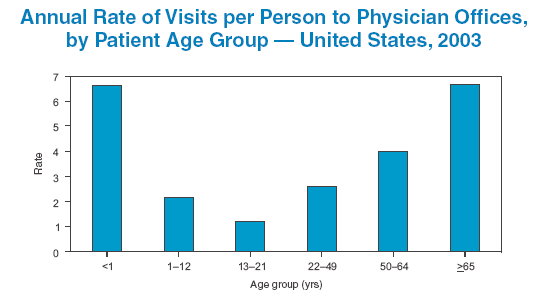
The thing that struck me initially was the chart showing video patterns by age.  It looks surprisingly similar to many charts of health care usage by age, such as the percentage of people with a primary care doctor by age (64% for 18-34 versus 90% for the 55+, according to The Physicians Foundation), or the number of physician visits by age, according to the CDC:

Quickstats

These patterns may not scare the health care industry the way that the corresponding video medium preferences scare the cable industry.  After all, health care professionals can rationalize, as people get older they'll use more health care services, and, anyway, we seem to be developing chronic diseases at earlier and earlier ages (e.g., the recent study on diabetes/pre-diabetes prevalence), so the health care industry can always expect people to come to them.

Maybe.  But maybe not; the future only resembles the past until it doesn't, and then it can look entirely different.  I think health care should be placing a few more bets in case the younger population decides to ditch accessing care in traditional ways like they're ditching cable.

An obvious parallel to Go90 would be with telehealth.  I keep reading about its explosive growth, but most of the uses still appear to be tied to health plans, with their deductibles, copays, and/or coinsurance.  There are some direct-to-consumer offerings, such as through American Well or Doctors on Demand, but they typically charge per visit or per month.

It'd be interesting to see what would happen if a health system or physician group let people access all the virtual care they wanted "for free," while still charging for in-person services.

CVS recently announced it would be piloting services with three different telehealth companies, mostly in connection with its MinuteClinic offerings.  CVS was the first to rid its stores of tobacco products, and it would be equally bold for them to offer a free telehealth service to customers.  One would think the in-clinic/in-store referrals could more than pay for the service, and I'd bet that some health systems might pay for the right to be local referral centers for specialty care.

But we shouldn't only be thinking about free video services just because that is what Go90 happened to do.  The underlying "problem" in reaching young people about health services is that, generally, they are more likely to be healthy -- or, at least, think they are healthy.  Seeing a doctor, even virtually, is just not something they really want to do, unlike watching TV shows on their smartphones.  If the health care industry wants to engage younger customers, it needs to do so for activities that they already want to do.

For example, pharmaceutical companies are already tapping Fitbits as a way to collect better data on people in clinical trials, and employer wellness programs have also jumped on the Fitbit bandwagon.  Both of those are intriguing starts, but I doubt either group of users have any doubts about the reason for the largess.  They only re-enforce the existing business models, rather than appear to upend them.

Similarly, there are already over a hundred thousand health-related apps, many of which have free versions, but not many of which threaten the existing health care business models.  When we see apps that lets you, say, perform and interpret your own labs or imaging for "free," that would be revolutionary.

The interesting question will be whether someone in the health care industry will voluntarily up-end their own business model, as Verizon is doing with theirs, or if someone from outside the industry does it for them.

I know what my bet would be.

Wednesday, September 9, 2015

The Right to Repair Ourselves

Geoffrey Fowler wrote an interesting article in The Wall Street Journal: We Need the Right to Repair Our Gadgets.  He describes how manufacturers have made it difficult for us to fix our personal tech gadgets (The Guardian concluded the same earlier this year), and discusses how he's managed to overcome some of those obstacles.

As I was reading it, I kept thinking, boy, replace "gadgets" with "our bodies" and "manufacturers" with "health care professionals," and he could be talking about health care.

Mr. Fowler asks the central question:  "At issue: Who owns the knowledge required to take apart and repair TVs, phones and other electronics?"  He asserts: "We’re more capable of fixing technology than we realize, but the electronics industry doesn’t want us to know that. In many ways, it’s obstructing us."

Again, think of the parallels for health care.

This obstruction takes many forms.  Mr. Fowler claims that some manufacturers control repair plans, limit access to parts, or use digital software locks to prevent consumers from fixing problems themselves.  If you have an Apple product with a bad battery, too bad, because you can't replace it yourself.  Apple uses special screws to ensure you can't even open the case.  Maybe they're just trying to prevent reverse engineering, but I suspect the people engaged in that are far more capable of defeating this tactic than some poor consumer who just wants to put a new battery in.

It's not that the manufacturers want to do the repairs themselves, mind you; they just want to make it difficult enough that, when there is a problem, you'll just give in and buy a new device.

This strategy of "planned obsolescence" has been around for a long time.  It has often been applied to automobiles, with their annual model changes, but it goes much further.  Popular Mechanics, for example, lists eight products "designed to fail," including not just cars and consumer electronics but also software, video games, ink cartridges, textbooks, and light bulbs.

Mr. Fowler took on the task of fixing a friend's broken Samsung TV.  Samsung grudgingly referred him to an authorized repair shop, insisting that the repairs needed to be done by a "qualified" technician.  Not surprisingly, the estimate from the repair shop was awfully close to the price of a new TV, so Mr. Fowler took to the Internet.

He quickly identified the likely source of the problem, found the necessary (and surprisingly cheap) replacement part, and viewed an applicable YouTube video.  He also discovered several communities of self-repair enthusiasts, one of which claimed they can fix two-thirds of the broken consumer electronics they see.  That's not only averting a lot of spending on replacements, but also reducing e-waste.

If you're old like me, you might remember that if you had a PC in the 1970's, you probably built (and repaired) it yourself.  If you had a TV in the 1960's, you probably had to routinely replace its vacuum tubes (Millennials, go ahead and google them).  You didn't have to be an expert mechanic to do most car repairs yourself until the manufacturers starting putting in all those computer circuits in the 1980's.

You might also remember when going to the ER was a rarity, and that it took a lot for your family doctor to send you to a specialist.  There was much more of a tendency to fix problems at the lowest level of care,including wait-and-watch and/or self-doctoring for many common problems.  Today a low grade fever is likely to cause an ER visit and a dose of antibiotics.

The analogy of planned obsolescence only goes so far because, of course, we can't get new bodies (although we can get some new parts, like knees, hips, or organs).  In health care, the goal seems to be to persuade us to get more care, and more expensive types of care at that.  It's a self-perpetuating cycle.

Think back to Mr. Fowler's central question.  Who owns the knowledge necessary to "repair" our health issues?  For centuries physicians have held that knowledge close to the vest as part of their professional expertise.  In the world of the Internet, much of that knowledge is now available to consumers -- e.g., Pew's 2013 report found 72% of Internet users had searched for health information, and Google's enhanced health search results now cover 900 conditions in-depth.

Thought leaders like Eric Topol have called this the "democratization" of health care."  Dr. Topol doesn't just think it is good for consumers to have access to all this information but also calls for patients to "own" their own medical data, rather than the current situation where it is locked in the silos of each provider who treats them.

I think Mr Fowler would agree with Dr. Topol.

Similarly, I suspect that Dr. Topol would draw the same conclusion about health care that Mr. Fowler does with consumer electronics: we're more than capable of "fixing" ourselves for many health issues, but the health care industry doesn't want us to know that and, in many ways, does its best to obstruct us from doing so (see a prior post).

A new book -- The Patient's Playbook --  urges us to take control of our medical care, rather than simply letting it happen to us, and I couldn't agree more (I love the description "tiger patients" used in one review).  However, to me it is a little like advice on how to survive if I happened to get caught in a hurricane.  I'd want the advice, but I'd rather know how to avoid hurricane in the first place.

A variety of health apps are starting to break down the traditional barriers about what consumers can do versus what health care professionals need to do for them, and that's great.  I just hope the FDA is very thoughtful in their reviews of such apps, not only which apps need their approval but also not underestimating what consumers can do on their own.

There are certainly many people with complex health issues that require sophisticated treatment by medical experts.  However, that is not the vast majority of us.  I'm not advocating that we should do brain surgery ourselves, but there are a host of health actions for which we shouldn't need medical interventions.

We've built a health care system that is like a Indy race car -- very advanced, very good at its intended purpose, driven by expert drivers, and, of course, very expensive, but not well suited for everyday driving.   We need a health care system that lets us do more of that everyday driving when it comes to more routine health care.

Do-it-yourself health care, anyone?

Saturday, August 29, 2015

More About Us, Less About Them

Something Amazon just did is worth those of us in health care paying attention to.  It doesn't have anything to do with their long-rumored interest in health care, and it wasn't even The New York Times disturbing profile of Amazon's supposedly brutal workplace culture.  Instead, it was the layoff of "dozens" of engineers at Lab126, Amazon's hardware development center, as first reported by The Wall Street Journal.  These were the first layoffs in the division's history.

Lab126 is responsible for Amazon's consumer devices, including their very successful Kindle e-reader and the new Fire TV.  More notably, though, they were less successful with the Fire tablet and they failed spectacularly with the Fire smartphone.  Connect the dots to the layoffs as you wish.
 
What makes this is a cautionary tale for the rest of us is that even Amazon -- which is noted for their prowess with their online consumer experience -- can't necessarily get the physical consumer experience right.  I think Wired captured the problem best, asserting that Amazon's consumer devices would have been more successful "if Amazon focused more on consumers, and less on consuming."

Now perhaps the relevance to health care may be clearer.

Consumer devices are all the rage in health care.  The global mHealth market is predicted to be $49b by 2020, with some 73 million units shipped in 2015 and an eye-opening CAGR of 47.9% expected from 2013 to 2020 (although other analysts already see slowing demand).  J&J, which knows a little something about consumer marketing and about health care, is teaming up with hardware manufacturer PCH to help spur the development of hardware for the consumer health space.  They plan to "accept everything from medical devices to consumer-facing activity trackers, provided they target an area of unmet need."

Some people -- e.g., Yuri Teshler, writing in Forbes -- think that all this consumer-oriented technology will help consumers "fix" health care.  That'd be nice, but I'm not so sure.

At the core of Amazon's devices is the goal to, well, get consumers to buy more stuff from Amazon.  They make it ridiculously easy to purchase almost anything consumers want to buy, and are constantly looking at how to expand their reach.  When that coincides with what people actually want to do, such as with the Kindle, it works out well for everybody.  When what consumers want is a smartphone that is the equivalent of an iPhone, and what it actually is best at is buying things, then not so much.

So I wonder: what is the goal of consumer devices in health care?  Are they intended to help us achieve better health -- or to consume more health care services?  I hope for the former but I fear it may end up being the latter.

Of course, none of this is limited to consumer health devices.  It's something that permeates the health care system.  Think about your most recent experience with the health care system: did you really feel your better health was the uppermost concern throughout the experience, or was it more about generating more services that you (or someone) had to pay for?  That may sound harsh, but I've sat too long in too many waiting rooms, filled out too many forms that I've already filled out elsewhere, and gotten too many confusing bills for wildly overpriced services to be nicer about it.  And I don't even use all that many heath services.

I was struck a couple of weeks ago by an opinion piece in JAMA: "Obstacles to Developing Cost-Lowering Health Technology."  It's authors, doctors Kellerman and Desai, note that:
The inventor’s dilemma is that creating a product that improves health is not enough; the product must also be able to generate a healthy return on investment. In the United States, the surest way to generate a healthy return on investment is to increase health care spending, not reduce it.
They cite a 2013 Rand report that reached much the same conclusions, and which offered a number of policy recommendations that, as best I can tell, no one is in any hurry to implement.  Rand concluded: "The longer we wait to institute fundamental reforms, the more money we will spend on health care offering little or no health benefit."

Yet we keep getting more of the same, to the point where, for example, even oncologists think cancer drug prices are too high.

Think about the terminology used in health care.  It speaks volumes about the underlying culture and its attitudes towards us.  Health care providers call us "patients."  Health plans call us "members."  Medicare and Medicaid call us "beneficiaries."    The name for one of the newest fads -- "patient centered medical homes" -- serves to remind us that we're not normally considered the center of our health care, and that the focus is on our medical care, not our health.

At least "consumer-directed health plans" pay lip service to us being in charge.

From what I understand, the term "patient" became part of medical terminology due to the Latin term for "one who is suffering," and the more general adjective "patient" reflects the implicit expectation that, as patients, we're expected to suffer in silence, not complaining about the pain or the various indignities we may endure.  

Well, the hell with that.

I've written before on this terminology problem, although I haven't heard any groundswell of suggestions for better terms to describe us when it comes to health care.  "Consumer" or "customer" are words that might describe us in other industries, but we're still not quite there when it comes to health care.  Perhaps they should just call us "Benjamins," as in "it's all about the Benjamins."

I'm all for people and organizations making money in health care, but I don't like to be seen as some kind of ATM for them either.  The health care industry needs to realize that we don't really want to be its customers, don't want to need to consume their services, and certainly don't want to have to be unduly patient about it when we do.

What we want is to be healthy.  Give us the devices, services, and experiences that make that as simple as possible and then you can call us whatever you want.

Sunday, August 23, 2015

Next Stop: Tinder for Docs

I've been thinking about patient-physician relationships.  After all, Annals of Internal Medicine published a shocking piece about bad physician behavior towards patients, and ZocDoc, the online physician appointment service, is valued at $1.8b after their most recent funding round.

I'll talk about each of those shortly, but first I want to talk about a phrase that started me thinking about the topic.

Noted entrepreneur/innovator/physician Jordan Shlain recently described the doctor patient relationship as "the atomic unit in medicine."   I assume he's using "atomic" in the original sense of being the smallest unit (although he also references data being the electrons orbiting the atomic unit, which means the metaphor really should be "nuclear").

Dr. Shlain urges that language should be specific and precise, so two things about his phrasing struck me: the order in which he describes the two parties, and the reference to medicine rather than to health.

In his description, it is a "doctor patient" relationship.  Maybe it is quibbling to pay attention to which party is listed first, but, come on, even the AMA uses "patient physician relationship" rather than "physician patient."  Even so, how many of us truly believe the physicians we deal with always "place patients' welfare above their own interest and above obligations to other groups," as the official AMA policy suggests?

Which leads to the Annals of Internal Medicine article.  I won't recount the specifics here, other than to say that in it describes two graphic instances of inexcusable physician behavior towards unconscious patients.  In an accompanying editorial, the editors say that the article "exposes medicine's dark underbelly."

The problem is less the appalling behavior -- there are badly behaving jerks in every profession -- as it is that none of the other medical personnel present even spoke up in protest.  The Annals editorial urged physicians to have the courage to "call our colleagues “assholes” when that label is appropriate."  And that, in itself, speaks volumes.  Verbally chastising them seems necessary but nowhere near sufficient.  Why not call upon them to report bad behavior -- to the hospital, to the state medical board, even to the police when "appropriate"?

It's supposed to be about protecting patients, not doctors.

The article has received widespread coverage -- e.g., The New York Times and U.S. News & World Report -- but, sadlyit is not the only story of its kind.  For example, an anesthesiologist in Virginia was caught on tape repeatedly verbally abusing her unconscious patient.  At least she was ordered to pay $500,000 in damages.

One wonders how many similar cases simply don't get caught.

I was dismayed by what the chair of committee on ethics for the American College of Obstetricians and Gynecologists said to The New York Times about the Annals article:  "What was the point of publishing this article?  No harm was done."  Seriously?  And this was the chair of their ethics committee?  No lay person could read the descriptions of what was done to the patients and view that "no harm was done."

Our relationship with our doctors must not be a very equal one.

Dr. Shlain also refers to the relationship in the context of medicine, rather than health.  We all like medical care when we need it, but, by legislative edict, the only people who are allowed to prescribe it for us are physicians, so of course physicians are part of medicine's "atomic unit."

However, we only care about medicine in the context of seeking better health.  That's the real goal, not more medicine -- and it's a stretch to say that the doctor-patient relationship is the cornerstone of our health.   It's part of good health, to be sure, but there are a lot of other important factors -- the person's attitudes and activities, their family's and social network's effects, and so on.

People are spending over $30b annually out of their own pockets on alternative and complimentary medicines, close to $50b on exercise equipment, even some $36b on organic foods.  These efforts don't seem to be doing much to make us healthier, mind you, but it shows that when it comes to our health, we're not just relying on what our physicians prescribe for us.

Our doctors aren't our only partners in health -- or necessarily our most important ones.

So how does any of this relate to ZocDoc?  Keep in mind that ZocDoc is a subscription-based service, with physicians paying a rumored $3,000 annual fee to belong.  It doesn't have a huge network of physicians.  It doesn't allow patients to see those physicians via video or online visits, as TelaDoc and other vendors do.  All it does is offer online appointment scheduling, and user-generated physician reviews.

And that appears to be worth $1.8b.

Surveys indicate that patients increasingly want their physicians to offer digital services, especially online appointment scheduling and bill pay, yet fewer than 20% say their current doctor offers those.  The rise of both retail clinics and telehealth further illustrate that more patients are choosing immediate access to medical professionals they do not know rather than waiting to see physicians they do know.  

I would be very curious to know how many of ZocDoc's patients make appointments with doctors with whom they already had relationships, or if they use the service for a one-time appointments, much like they might order a ride from Uber.

A 2012 survey found that 22% of American adults didn't have a primary care doctor, and the percentage drops off rapidly by age -- 90% for 55+ versus 64% for those 18-34.  If I were a primary care physician I'd be pretty worried about getting those younger populations into a relationship -- or keeping them in one.

The people who talk most reverently about the patient-physician relationship these days seem to be either physicians or politicians, not patients  On average, people supposedly see 19 doctors over the course of their lives, with whom they have different types of relationships for varying durations.  They're not always all that special.

If doctors are going to treat patients disrespectfully, be more interested in medicine than health, or treat patient encounters like transactions (e.g., visits of fifteen minutes or less), then they shouldn't be surprised if patients start not placing much value on the relationship.

If we're not careful, we may get to the point where we pick our physicians like we were picking a date on Tinder, based purely on proximity and superficial characteristics.  Let's hope not.

Friday, August 14, 2015

What Health Care Needs Are Some Zombies

Finally, some good health care news: according to Accenture, half of digital health start-ups are going to fail within two years.

No, really: that's the good news.

Accenture projects that funding for digital start-ups is going to boom over the next few years, reaching $6.5b annually by 2017.  Their analysis categorized four key areas of funding from 2008 - 2013: infrastructure ($2.9b), treatment ($2.6b), engagement ($2.6b), and diagnosis ($2.1b).  They stress that the start-ups that will succeed will do so by combining capabilities across the four areas, such as by use of integrated Social, Mobile, Analytics, Cloud and Sensor technologies ("SMACS").

This boom shouldn't come as much of a surprise.  For example, use of physician virtual visits is predicted to double by 2020, and I wouldn't be surprised if that prediction is too low.  The Wall Street Journal recently profiled several start-ups that are trying to be a "Uber for health care."  As the founder of one of those start-ups, RetraceHealth, told the WSJ, "Once you've had pizza delivered, you rarely go pick up pizza again."

There is a lot of low-hanging fruit, and maybe even some pizza, in health care that digital health start-ups could help us pick off.

Accenture concludes:
All stakeholders—payers, providers, IT vendors, life sciences, pharma and industry newcomers—will need new strategies to respond to inevitable digital disruption
and its potential to dis-intermediate target patients, health consumers and members. Traditional healthcare organizations must develop ways to be relevant to the new health consumer, by encouraging and embracing, rather than resisting, digital
healthcare start-ups.
All that is well and good, and probably, to some extent, even true.  So where are the zombies?

The trouble is, a lot of those start-ups aren't going to make it.  Of some 900 start-ups that Accenture looked at, 51% had received less than $50 million between 2008 - 2013 -- and hadn't received any funding in over 20 months. Maybe they're not receiving more funding because they've, somehow, become spectacularly profitable, but more likely they've become what Accenture calls zombies.  They're dead but they don't quite know it.

Accenture views this as good news for several reasons.  One is that the start-ups have a pool of innovative talent who should be attractive to other health care organizations.  The start-ups may be acquired less for their products or their technology than for the people who created them. 

And, of course, some of those products or technology may have value.  Those 900 zombie start-ups had, by Accenture's count, 1,700 patents, some of which could take off in the right hands, especially if paired with the right array or complimentary technologies and a wider built-in customer base.

Big technology companies -- Apple, Google, Microsoft, etc. -- have relied on the strategy of buying start-ups to gain access to their talent and patents.  Down-on-their-luck companies like Blackberry or Kodak still have a 'treasure trove" in their patent portfolios that can keep them afloat or make them more attractive for an acquirer.

Accenture mixes metaphors by recommending that health care organizations be "like vultures circling prey" when it comes to the zombie start-ups.  I.e., "innovative enterprises will swoop in on digital health start-ups to capture relevant and at-the-ready resources."  (I haven't seen vultures attacking zombies in any horror movies, although shout-out to George Romero about the idea).

The trick, of course, is what to do with a zombie start-up.  I'm not an expert on the zombie genre, but I know that usually you either kill them or they kill you -- or turn you into a zombie.  Making them work for you is harder to do (except maybe in voodou movies, but that is a whole other metaphor).

It's not enough to pick up some innovative people and their ideas.  The organization has to be open to, even eager for, change, and change is something that many health care organizations often do grudgingly (or only if significant impacts on reimbursement are involved).

A recent op-ed in NEJM, by Asch and Rosin, "Innovation as a Discipline, Not a Fad" is on point.  While their examples didn't address acquiring zombie start-ups, they do speak to the necessary mind-set: how can we, as an organization, act faster and test more ideas less expensively.  It is exactly the kind of attitude Accenture is urging.  Zombie start-ups offer one way -- not the only way -- towards that end.

A caution to this call for innovation comes in a post in MobileHealthNews by Bradley Merrill Thompson, a lawyer who specializes in FDA and other regulatory matters.  He recognizes the need for health care to change, applauds Uber's business model and technology, but casts doubt on carrying their analogy too far into health care.  Uber has a somewhat reckless attitude towards regulatory barriers, believing they don't apply and/or are outdated, and Mr. Thompson doesn't think this is the way to go in health care.

He gives five well thought out reasons for his caution, which I won't rehash here, but I do want to comment on two of his statements:
  • "I’ve been doing this regulatory work for 30 years, and in that time I can honestly tell you that very rarely is a good idea illegal." 
  • "Laws are there for reason, and in the case of healthcare that reason often includes protecting patients from harm."
I'm not so sure I can agree with those, or his conclusion that we shouldn't be a little more reckless about our innovation.  I worry that too much of health care's regulatory structures are to protect providers, or the medical-industrial complex, rather than patients, and that those structures can make good ideas -- ideas that are good for patients -- illegal, or at best so difficult to comply with that they might as well be (see, for example, posts on the cartel-like behavior of state licensing boards or our crazy-quilt approach to medical education)  

Health care providers have historically stubbornly resisted being measured, and it is telling that a recent study in JAMA Internal Medicine which looked at 16 national collections of performance measures found that only 7% addressed overuse.  The authors concluded that the measures may implicitly endorse the "more is better" attitude so prevalent in our health care system.  

Whatever happened to "first, do no harm"?
 
So when it comes to protecting patients from harm, to doing what's best for the patient, yeah, maybe a (metaphorical) zombie apocalypse wouldn't be such a bad thing.  Maybe they can infect health care with some new attitudes.